 8.6 out of 10 based on 81326 reviews







.svg)
.svg)
.svg)
.svg)
.svg)
.svg)


 Menu
Menu
-
 Vaporshop
All Categories
Vaporshop
Vaporshop
All Categories
Vaporshop
- Top 10 Vaporizers
- Spare Parts & Accessories
- AirVape XS GO (2021)
- Arizer Air MAX
- Arizer Extreme Q
- Arizer Solo 2
- Arizer V-Tower
- Arizer XQ2
- Boundless CFC 2.0 Vaporizer
- Boundless CFX
- Boundless TERA (V3)
- CRAFTY+
- DaVinci IQC
- Dr. Dabber Boost EVO
- DynaVap VapCap "M" PLUS 2023
- DynaVap VonG (i) Titanium
- Flowermate Aura
- Flowermate Cap Pro
- Flowermate Slick
- Flowermate V5.0S Pro
- G Pen Elite II
- G Pen Micro+
- G Pen Roam
- Hyer Big-E Rig
- MIGHTY+
- PAX Mini
- PAX Plus
- PLENTY
- Puffco Peak Smart Rig
- Puffco Plus
- Storm Vaporizer
- The Proxy (Puffco)
- VOLCANO CLASSIC
- VOLCANO HYBRID
- Vapman 2.0
- Vapman Click
-
 Smartshop
All Categories
Smartshop
Smartshop
All Categories
Smartshop
- Top 10 Smartshop
- Zamnesia Gift Cards
- After Party
- Aphrodisiacs
- Aromatherapy
- Blue Lotus
- Capsule Machines
- Crystals, Gemstones & Minerals
- Dream Herbs
- Drug Tests
- Extracts
- Happy Caps
- Herbal Tea
- Herbs & Seeds
- Incense
- Kanna
- Kratom
- LSA Seeds
- Mescaline Cactus
- Microdosing
- Nootropics
- Relaxing
- Salvia divinorum
- Smart Seeds
- Stimulants
- Supplements
- Tinctures
- Vape Herbs
-
 TRIBE
All CategoriesTRIBE
TRIBE
All CategoriesTRIBE
- My Membership
- Spend Gift Points
- TRIBE Sale
- Exclusive products
- Earn Extra Gift Points
- Early Access
- Refer a Friend
- Information
 Mushroom Dosage Calculator


 Help
HelpThe Legalisation Effect: What Really Happens When a Country Legalises Cannabis

Based on the European Cannabis Culture Report 2025, an analysis of 6,046,287 cannabis seeds across 25 European countries (January 2024 to December 2025)
On 1 April 2024, Germany became the largest EU country to legalise cannabis for personal cultivation. It was supposed to be a German story. It wasn’t.
What followed was not a single policy event but a continental shift: measurable, traceable, and in some cases deeply counterintuitive. Using real transaction data from over six million cannabis seeds purchased across 25 European countries, we can now reconstruct for the first time what actually happens when a major European country legalises cannabis.
The findings go far beyond Germany’s borders.
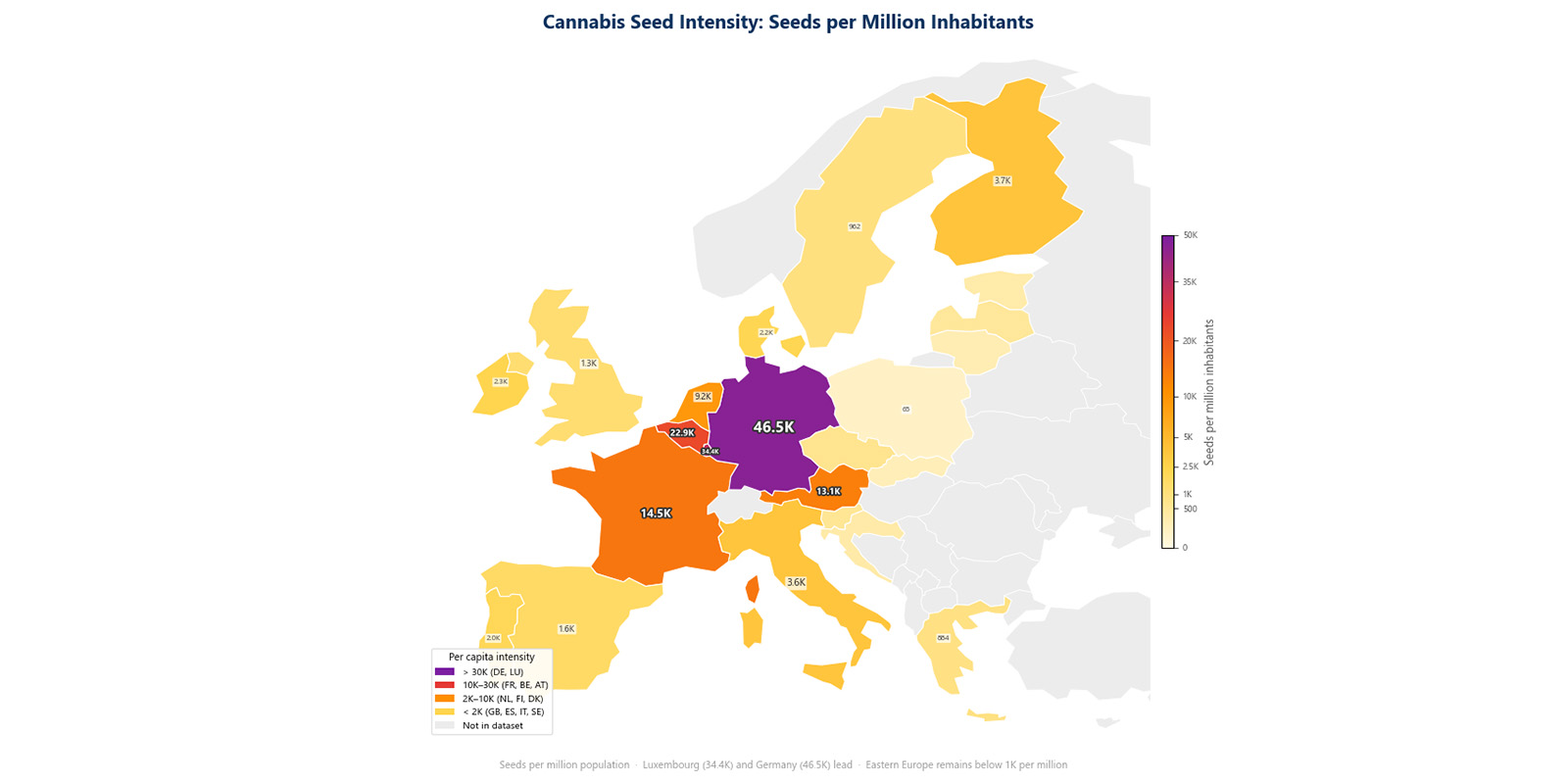
Figure 1: Cannabis seed purchases per capita across Europe. Germany and Luxembourg emerge as the most active markets, but the story is continental.
The Stockpiling Rush
Before the law even took effect, the market moved.
In March and April 2024, Germany represented 73.4% of all European seed orders. Nearly three-quarters of the entire continent’s purchases came from a single country. To put that in perspective, Germany’s normal share of the European market is approximately 64.6%. Legalisation added roughly nine percentage points of pure surge demand in just two months.
This was anticipatory buying. German consumers, knowing that legal home growing was days away, stockpiled seeds in advance. Forums lit up with strain recommendations. First-time buyers entered the market alongside experienced growers expanding their collections. The rush was intense, concentrated, and short-lived.
Then came the correction. By Q2 2025, German online seed volume had dropped -26.3% compared to Q2 2024.
This number requires careful interpretation. The -26.3% does not mean the German cannabis market shrank. It means consumers shifted channels. Post-legalisation, physical grow shops proliferated across Germany. Garden centres started carrying seeds, dedicated cannabis retail opened in major cities, and local grow shops absorbed a significant portion of demand that had previously gone through international online retailers.
The German market didn’t contract. It moved offline.
This distinction matters for anyone interpreting European cannabis market data: online-only metrics will always undercount post-legalisation markets. The real market is larger than the digital footprint suggests.
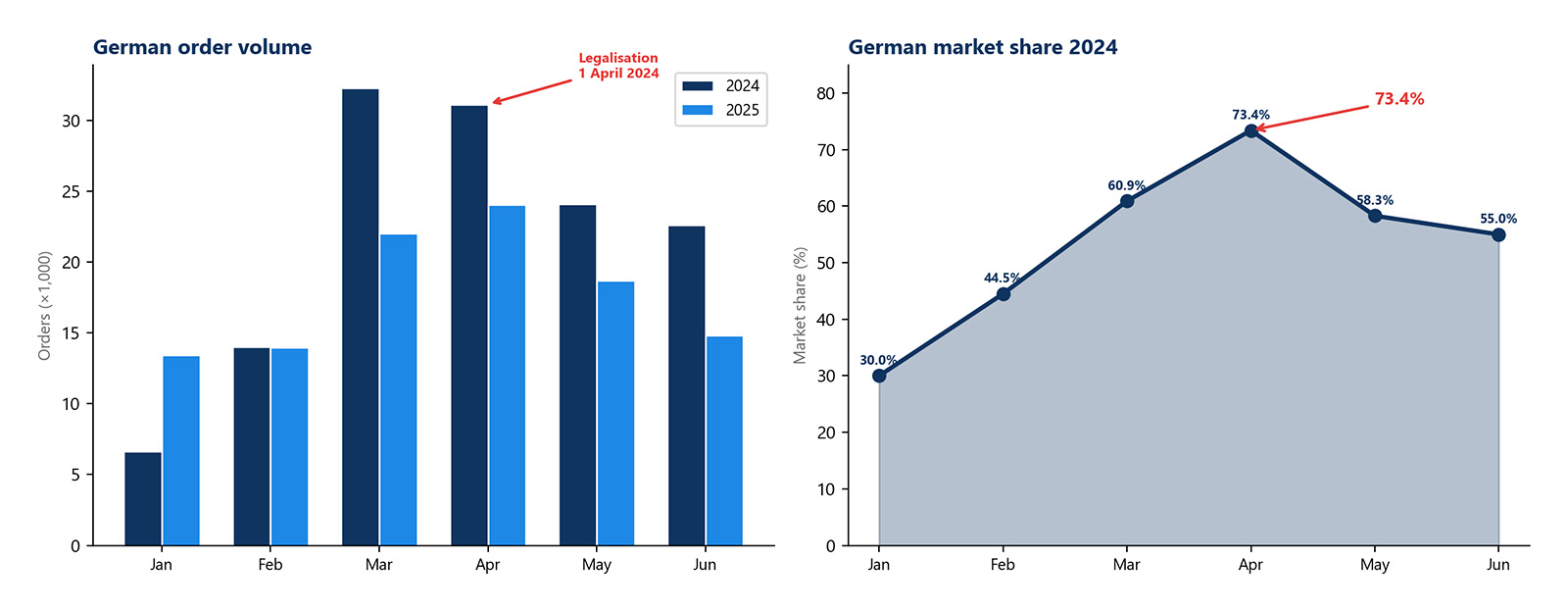
Figure 2: The legalisation timeline. A sharp stockpiling spike in March and April 2024, followed by normalisation as demand shifts to local retail channels.
The Domino Effect
Here is the finding that no one predicted.
While Germany’s own online market declined after the initial rush, every single one of Germany’s neighbouring countries grew. Not one. Not a few. All of them.
| Country | Year-on-Year Growth | Distance from Germany |
| Austria | +117% | Direct neighbour |
| Belgium | +42% | Direct neighbour |
| Netherlands | +30% | Direct neighbour |
| France | +20% | Direct neighbour |
Austria’s surge is the most dramatic, more than doubling its market in a single year. Belgium’s +42% is substantial for an already mature market. Even the Netherlands, a country with decades of coffeeshop culture, saw a 30% increase in seed purchases. France, with a weaker linguistic connection to Germany but strong geographic proximity, grew a measurable 20%.
The mechanism is what we call the cannabis awareness spillover effect. When Germany legalised, the event didn’t stay within German borders. It travelled through media coverage, cross-border conversations, shared social media, YouTube channels, and the general normalisation of cannabis culture that follows any major legalisation event.
Austrian consumers watched German-language YouTube growers celebrate legal harvests. Belgian forums discussed the implications for Benelux policy. Dutch consumers, even with coffeeshop access, became newly interested in growing their own. French border regions experienced the shift most directly.
Meanwhile, Germany itself normalised at -18.4%. This was not because interest declined, but because the market redistributed across channels.
The implication is significant: legalisation in one country doesn’t just change that country. It creates awareness and demand across borders.
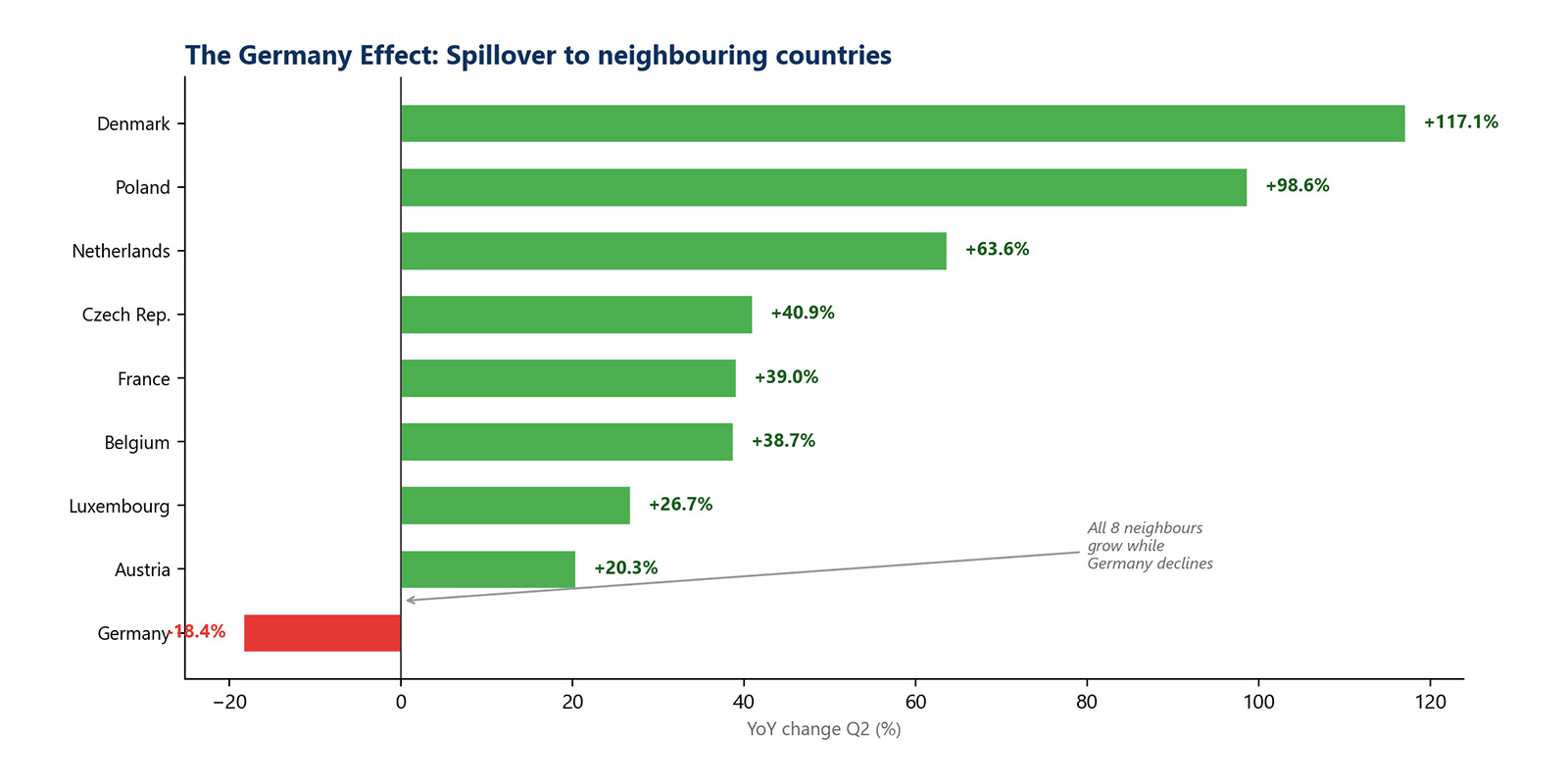
Figure 3: The domino effect. All of Germany’s neighbours grew while Germany’s online market normalised. Austria’s +117% is the most dramatic spillover ever recorded in European cannabis data.
The Second Ring: Beyond Direct Neighbours
The spillover didn’t stop at Germany’s borders. Countries further afield, with no shared border, also showed significant growth, suggesting that legalisation awareness spreads through media and culture, not just geography.
| Country | Year-on-Year Growth | Proximity to Germany | Likely Driver |
| Poland | +98.6% | Direct neighbour (east) | Geographic proximity + German-language media exposure |
| Denmark | +55% | Near-neighbour (north) | Scandinavian media coverage + existing liberal attitudes |
| Finland | +45% | Distant | Small base, but Europe’s most loyal customer segment |
| Ireland | +20% | Distant | English-language media coverage of legalisation |
| Portugal | +15% | Distant | Modest but measurable |
Poland’s near-doubling is the most striking number in this table. Despite operating under one of the more restrictive cannabis frameworks in Europe, Polish consumers responded to German legalisation with explosive growth, almost certainly driven by geographic proximity and exposure to German-language media and culture in border regions.
Denmark’s +55% makes it the fastest-growing established market in Western Europe. Finland’s +45% growth comes from a small base, but Finnish growers are Europe’s most experienced and loyal segment. This isn’t casual interest, it’s committed growers expanding their activity.
By contrast, mature Western European markets showed mild contraction: France, Belgium, and the Netherlands each declined between -5% and -7%. This isn’t declining interest, it’s market maturity. These countries have established, saturated grower communities. Their growth phase happened years ago.
The European cannabis seed market is redistributing, not contracting. Growth is shifting from established Western European cores to emerging Scandinavian and Eastern European markets. Poland’s +98.6% is the signal: even under restrictive laws, proximity to a legalised neighbour drives explosive growth.
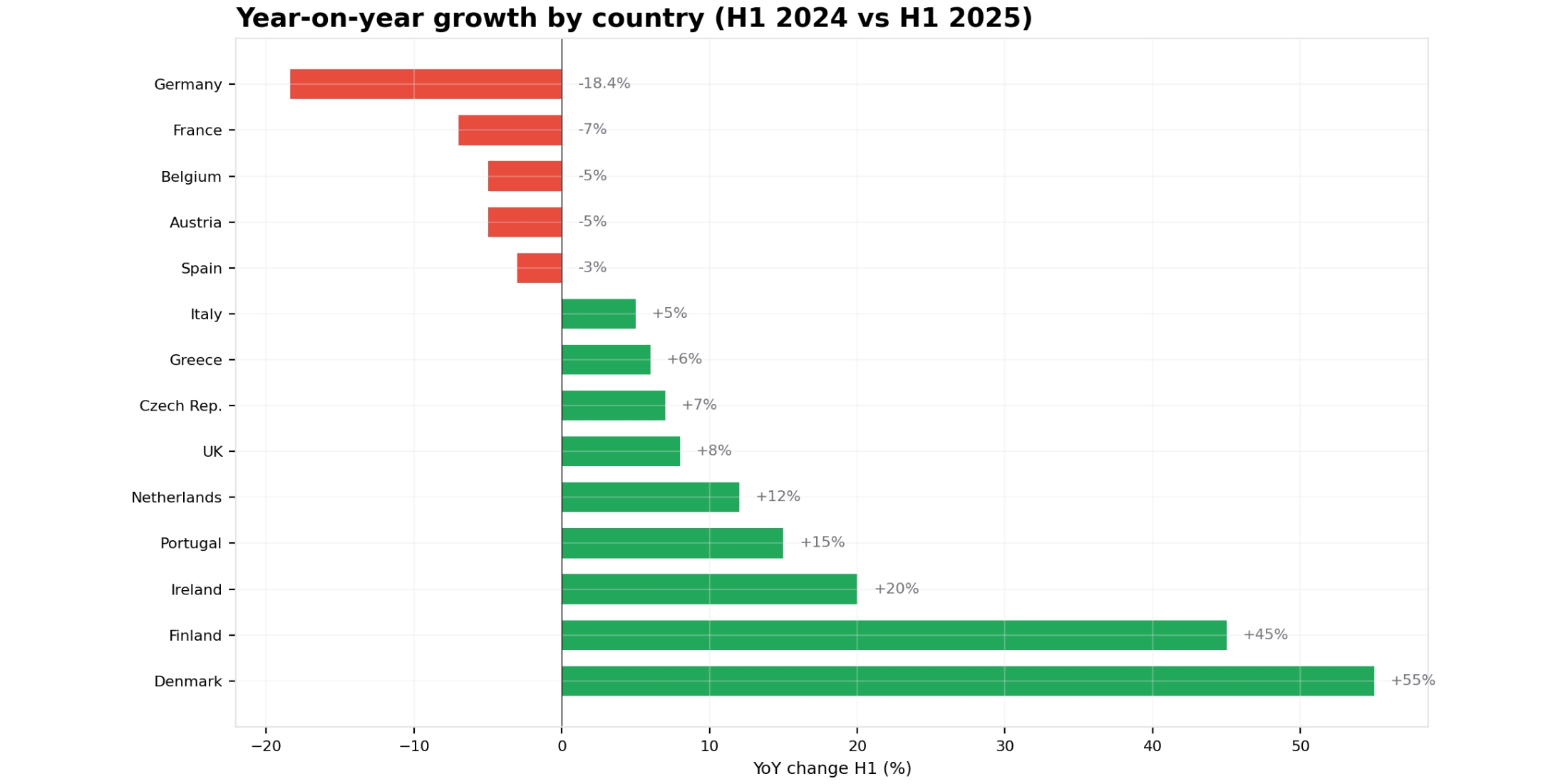
Figure 4: Year-on-year growth across European markets. The pattern is clear: emerging markets are surging while mature markets stabilise.
The DACH Twin Effect
Austria’s +117% deserves closer examination, because it reveals something deeper than simple spillover. Germany and Austria don’t just share a border. They function as a single cannabis culture that happens to span two countries with different legal frameworks.
The evidence is striking:
| Metric | Germany | Austria |
| Experience Score | 57.0 | 57.1 |
| Autoflower Ratio | ~53% | ~55% |
| Top 3 Strains | Runtz, Purple Haze, Blueberry | Runtz, Purple Haze, Blueberry |
| Vaporizer Consumption | 36.9% | 34.1% |
| Cultural Similarity Score | n/a | 94% |
Germany and Austria scored a 94% cultural similarity, the highest of any country pair in Europe. Their grower communities are statistically identical in experience level, strain preferences, consumption methods, and growing styles. The only meaningful difference is their legal framework, and even that distinction is shrinking.
Austria’s +117% surge wasn’t random growth. It was the German legalisation, experienced through shared language, shared media, shared YouTube channels, shared Instagram accounts, and shared growing forums. When Germany legalised, Austrian consumers didn’t just hear about it. They experienced it as if it happened in their own country. The same influencers they follow, the same forums they read, the same content they consume all shifted to a post-legalisation reality overnight.
For policymakers, this carries a critical lesson: legalisation in one country of a linguistic or cultural bloc effectively legalises the conversation across the entire bloc. Austria, Switzerland, and Liechtenstein all experienced Germany’s legalisation through German-language media. The policy debate is no longer contained by national borders. It follows cultural and linguistic lines.
When the next German-speaking country moves toward legalisation, it won’t be starting from zero. The cultural groundwork is already laid.
What This Means
Germany’s legalisation provides the first empirical template for what happens when a major European country changes its cannabis policy. Three patterns emerge clearly from the data.
1. The Legalisation Sequence Is Predictable
Germany established a four-stage pattern that any future European legalisation should expect to follow:
Stage 1: Stockpiling surge. Consumers buy heavily in the weeks before and after the law takes effect. Online retailers see a dramatic but temporary spike.
Stage 2: Channel shift. Within 6 to 12 months, demand migrates from international online retailers to local physical retail. Grow shops, garden centres, and dedicated cannabis stores absorb an increasing share of the market.
Stage 3: Online normalisation. Online seed sales decline, not because the market shrinks, but because the market diversifies across channels. Online metrics undercount the real market.
Stage 4: Neighbour spillover. Surrounding countries experience measurable growth driven by media exposure, cultural proximity, and the normalisation of cannabis in shared media environments.
Any country that legalises next, whether the Czech Republic, Luxembourg expanding its framework, or Malta broadening access, should expect this same sequence.
2. The Second-Ring Effect Is Real
Spillover extends well beyond direct neighbours. Media, culture, and language carry the legalisation effect further than geography alone. Poland’s +98.6% growth, from a country with restrictive cannabis laws that shares an eastern border with Germany, proves that proximity to a legalised country generates demand regardless of local policy.
The implication: future legalisations won’t just affect their immediate neighbours. They’ll ripple outward through every cultural and linguistic channel available.
3. Online Data No Longer Tells the Full Story
Post-legalisation, online seed sales decline as local retail absorbs demand. Germany’s -26.3% online decline does not mean the German cannabis market shrank. It means the market moved to channels that are harder to measure.
Analysts, journalists, and policymakers relying on online-only data will systematically underestimate post-legalisation markets. The true market size is larger than any single data source suggests.
Read the full European Cannabis Culture Report 2025 and explore the complete dataset with deeper insights into cannabis seed purchasing patterns across Europe.